Embeddings and Vector Databases: The Search Layer Behind Real AI Applications
Summary
Embeddings convert meaning into vectors; vector databases make those vectors searchable. Together they form the retrieval foundation behind RAG, semantic search, and enterprise AI assistants.
Short answer: Embeddings convert text into vectors so software can search by meaning, not just keywords. Vector databases store those vectors and find the nearest matches at query time. Together they form the retrieval layer behind RAG — the part that lets an LLM answer from your documents, filings, and internal knowledge.
Most people see AI applications from the outside: a chat box, a question, an answer. Behind a useful AI application, there is usually an important hidden layer — semantic search — built from two concepts: embeddings and vector databases.
If Large Language Models are the reasoning engine, embeddings and vector databases are often the memory and search layer. This is what allows an AI system to answer questions from your own documents, filings, product manuals, support tickets, internal wikis, or financial reports.
Without this layer, the model mostly answers from what it learned during training. With it, the model can answer from your actual data. That is the difference between a demo chatbot and a real enterprise AI system.
For how to choose between RAG patterns once retrieval is in place, see RAG vs Graph RAG vs Agentic RAG. For the broader platform picture, see From AI Model Consumer to AI Application Builder.
What is an embedding?
An embedding converts text, images, audio, or other data into a list of numbers — a vector that captures meaning.
For text, it means converting a sentence, paragraph, or document section into a numerical representation. These two sentences use different words:
- "Revenue increased because of higher loan growth."
- "The bank reported strong advances during the quarter."
A keyword search may not connect them. An embedding model places them close together in vector space because they are semantically similar.
Embeddings allow software to search by meaning, not just exact words.
Simple mental model
Think of an embedding as coordinates on a map. On a geographic map, Chicago and Milwaukee are close because they are near each other. In embedding space, two pieces of text are close because their meanings are similar.
Phrases like "cash flow statement," "operating cash flow," "free cash flow," and "cash generated from operations" belong close together even when the words differ. That helps a system understand that users may ask the same thing in many different ways.
Why keyword search is not enough
Traditional search works when users know the exact terms. Search for `dividend payout ratio` and keyword search finds documents containing those words.
But if the user asks "How much profit did the company return to shareholders?" a keyword system may miss the best answer. A semantic search system can connect the question to dividends, buybacks, payout ratio, capital allocation, and shareholder returns.
Embeddings bridge the gap between how humans ask questions and how information is stored in documents.
What is a vector database?
Once text is converted into embeddings, you need somewhere to store and search those vectors. That is what a vector database does.
The basic flow:
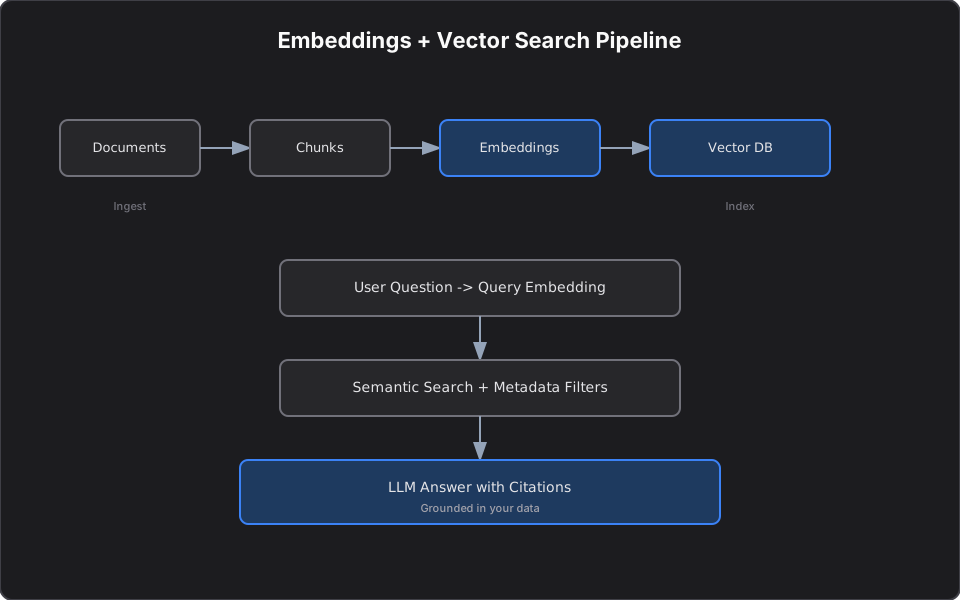
1. User asks a question. 2. Convert the question into an embedding. 3. Search the vector database for the most similar document chunks. 4. Send those chunks to the LLM as context. 5. Generate an answer with citations.
This is the foundation of Retrieval-Augmented Generation.
Why this matters for real AI products
A basic LLM can answer general questions. Most businesses need answers from private, changing, domain-specific information:
- What changed in this company's latest filing?
- Which risk factors were added this year?
- Summarize customer complaints related to delayed payments.
- Compare management commentary from the last four quarters.
The LLM alone may not know this information. Embeddings and vector databases make it searchable.
Finance example
Finance is one of the best domains for this architecture because so much information is document-heavy: annual reports, quarterly filings, earnings transcripts, investor presentations, credit rating reports, exchange announcements, and management commentary.
A user may ask: "Why did operating margin decline even though revenue increased?"
The answer may be spread across revenue growth, raw material cost, employee cost, finance cost, segment performance, management discussion, and one-time expenses. Vector search has a better chance of retrieving conceptually related sections even when exact words do not match.
That is where the AI product becomes a research assistant, not just a chatbot.
Chunking: the step people underestimate
Before creating embeddings, documents are usually split into chunks. This step sounds boring, but it often decides whether RAG works or fails.
- Too small: "Margins declined." — no explanation of why.
- Too large: noisy retrieval because the chunk covers unrelated topics.
- Just right: "Operating margins declined during the quarter due to higher raw material costs, increased freight expenses, and lower utilization in the export segment."
A good chunk contains enough context to answer a question, but not so much that it becomes unrelated to the query.
Metadata matters as much as embeddings
A common mistake is thinking vector search alone is enough. It is not. Metadata is critical.
For financial documents, useful metadata includes:
- Company symbol and name
- Document type and filing date
- Financial year and quarter
- Source URL, page number, and section name
- Industry and country
This allows filtering before or after vector search:
- "Search only HDFC Bank earnings transcripts from the last four quarters."
- "Search only annual reports for Indian IT companies."
Without metadata, the vector database may return semantically similar but irrelevant results. Good AI systems combine semantic search with structured filters.
Embeddings are not magic
Embeddings are powerful, but imperfect. They can retrieve the wrong context, miss exact numbers, confuse similar companies, struggle with tables, and return outdated information.
If a user asks "What was the exact debt-to-equity ratio in FY2024?" vector search may retrieve a related paragraph about debt but miss the table containing the ratio.
Production systems should not rely on vector similarity alone. They need metadata filtering, re-ranking, citations, structured data lookup, evaluation tests, fallback behavior, and confidence checks. The goal is not just to retrieve something — the goal is to retrieve the right thing.
Vector database vs normal database
A relational database is excellent for structured queries:
SELECT revenue
FROM financials
WHERE symbol = 'TCS'
  AND fiscal_year = 2024;
That is precise and deterministic. A vector database is useful for semantic questions like "Find sections where management discusses demand slowdown" — when you do not know the exact words used. The company may say "softness in discretionary spending," "delayed client decision-making," or "weak macro environment."
The best systems use both: relational databases for facts, vector databases for meaning, LLMs for synthesis.
Practical architecture
Document ingestion
   ↓
Text extraction
   ↓
Chunking
   ↓
Metadata enrichment
   ↓
Embedding generation
   ↓
Vector database storage
   ↓
User query → query embedding
   ↓
Semantic search + filters
   ↓
Re-ranking → context assembly
   ↓
LLM answer with citations
This pattern is reusable across internal knowledge assistants, support automation, financial research, legal search, compliance Q&A, and engineering documentation.
C# example: searching financial filing chunks
Keep embedding generation, vector search, and answer generation separated:
public sealed record FilingChunk(
    string Id,
    string Symbol,
    string DocumentType,
    DateTime FilingDate,
    string Text,
    float[] Embedding);

public sealed record SearchResult(
    string ChunkId,
    string Text,
    string Source,
    double Score);

public interface IEmbeddingService
{
    Task<float[]> CreateEmbeddingAsync(string text, CancellationToken cancellationToken);
}

public interface IVectorSearchRepository
{
    Task<IReadOnlyList<SearchResult>> SearchAsync(
        float[] queryEmbedding,
        string symbol,
        int topK,
        CancellationToken cancellationToken);
}

public sealed class FilingSearchService
{
    private readonly IEmbeddingService _embeddingService;
    private readonly IVectorSearchRepository _vectorRepository;

    public FilingSearchService(
        IEmbeddingService embeddingService,
        IVectorSearchRepository vectorRepository)
    {
        _embeddingService = embeddingService;
        _vectorRepository = vectorRepository;
    }

    public async Task<IReadOnlyList<SearchResult>> SearchFilingsAsync(
        string symbol,
        string userQuestion,
        CancellationToken cancellationToken)
    {
        var queryEmbedding = await _embeddingService.CreateEmbeddingAsync(
            userQuestion,
            cancellationToken);

        return await _vectorRepository.SearchAsync(
            queryEmbedding,
            symbol,
            topK: 8,
            cancellationToken);
    }
}
Now a user can ask: "What risks did management highlight in the latest annual report?" The backend converts the question into an embedding, searches filing chunks, retrieves the most relevant sections, and passes them to the LLM with citations. That is the core of RAG.
What makes a vector search system good?
A good vector search system is not just about storing embeddings. It needs engineering discipline:
1. Source traceability — every answer points back to the source. Non-negotiable in finance, legal, and compliance. 2. Freshness — embeddings must update when source documents change. 3. Filtering — a query about one company should not retrieve another company's filing because the text is similar. 4. Evaluation — a test set of real questions measuring retrieval accuracy, citation quality, and hallucination rate. 5. Cost control — caching, batching, lifecycle policies, and smart retrieval limits for embeddings, storage, and LLM calls.
Common mistakes
- Embedding everything without thinking — noisy, duplicate, or badly chunked documents produce noisy retrieval.
- Treating vector search as a database replacement — use structured data for exact numbers; use vector search for explanation and themes.
- Skipping citations — without citations, users cannot verify the answer. Trust matters more than clever wording.
How I would build this for a finance platform
Phase 1 — Document search: annual reports, quarterly reports, investor presentations. Questions against one company: key risks, revenue mix changes, margin decline, management demand commentary.
Phase 2 — Filing timeline: extract events (dividends, auditor changes, promoter holding changes, debt rating updates) and turn raw filings into intelligence.
Phase 3 — Cross-document research: compare last four quarters of management commentary, track debt risk over time, find capacity expansion mentions.
Phase 4 — Hybrid search: combine vector search with structured financial data — find companies where revenue grew more than 15% but margins declined, then explain why using filings. The database finds the companies; vector search retrieves the explanation; the LLM synthesizes the answer.
Embeddings are infrastructure, not a feature
The biggest mindset shift: embeddings are not just an AI feature. They are infrastructure — like authentication, logging, caching, and search. Once the embedding layer exists, many features become easier: document Q&A, semantic search, AI summaries, duplicate detection, recommendation systems, and compliance monitoring.
Engineering teams should design embeddings as a reusable platform capability, not a hackathon experiment.
Final takeaway
Embeddings convert meaning into numbers. Vector databases make those meanings searchable. Together they create the retrieval layer behind modern AI applications.
But the real value does not come from simply adding a vector database. It comes from building a complete retrieval system: clean documents, good chunks, useful metadata, high-quality embeddings, reliable vector search, re-ranking, citations, evaluation, cost control, and freshness.
That is what separates a toy chatbot from a production AI system. For enterprise and finance applications, this layer is especially important because the answer must be grounded, current, and traceable.
The future of AI products will not be only about bigger models. It will be about better systems around the models — and embeddings plus vector databases are one of the most important parts of that system.
Related reading
- RAG vs Graph RAG vs Agentic RAG — choosing the right retrieval architecture
- Private RAG Systems Without External APIs — self-hosted RAG pipelines
- From AI Model Consumer to AI Application Builder — RAG in the platform progression
Frequently asked questions
- What is an embedding in AI?
- An embedding is a numerical vector that represents the meaning of text, images, or other data. Similar meanings produce vectors that are close together in vector space, enabling semantic search.
- What is the difference between a vector database and a normal database?
- A relational database answers precise structured queries with exact matches. A vector database finds the nearest semantic matches for embedding vectors — useful when you do not know the exact words in the source documents.
- Why is chunking important for RAG?
- Chunks are the units you embed and retrieve. Chunks that are too small lose context; chunks that are too large add noise. Chunking strategy often determines whether a RAG system works in production.
Related reading
RAG vs Graph RAG vs Agentic RAG: How to Choose the Right Architecture
Standard RAG, Graph RAG, and Agentic RAG all connect LLMs to private data — but they solve different problems. Match the architecture to the question: retrieval, relationships, or reasoning.
Private RAG Systems Without External APIs
Mid-sized teams can build secure, self-hosted AI assistants with open-source models, vector stores, and RAG — without routing proprietary data through third-party APIs.
From AI Model Consumer to AI Application Builder
A practical guide for .NET engineers moving from chat prompts to RAG, MCP servers, agents, and agentic workflows — with security patterns, architecture diagrams, and platform mental models.