Private RAG Systems Without External APIs
Summary
Mid-sized teams can build secure, self-hosted AI assistants with open-source models, vector stores, and RAG — without routing proprietary data through third-party APIs.
Generative AI content is everywhere; execution is rarer. Mid-sized companies often feel overwhelmed by the volume of information available. The reality is that with the right approach, even small teams can develop powerful AI tools using their own data — without relying solely on OpenAI or external APIs.
One particularly practical use case is a private, self-hosted chatbot or web/mobile interface powered by Retrieval-Augmented Generation (RAG).
The architecture in two pipelines
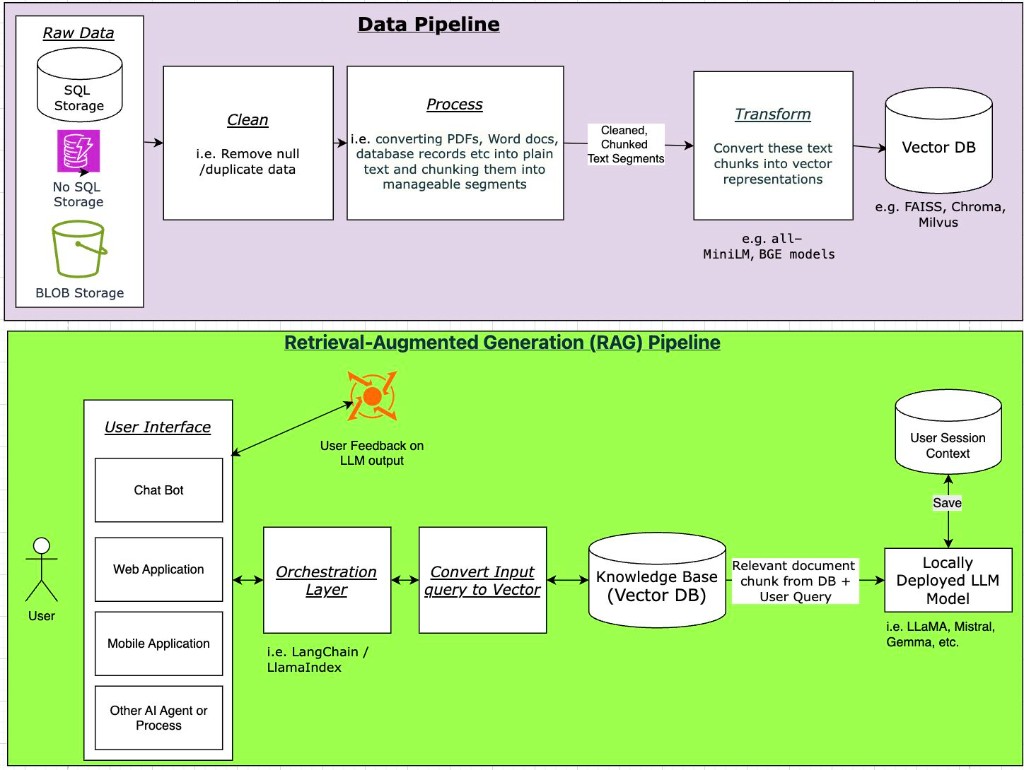
The data pipeline ingests raw data from SQL, NoSQL, and blob storage, cleans nulls and duplicates, processes documents into text chunks, transforms chunks into vector embeddings (using models like all-MiniLM or BGE), and stores them in a vector database (FAISS, Chroma, or Milvus).
The RAG pipeline handles user queries through an orchestration layer (LangChain or LlamaIndex), converts queries to vectors, retrieves relevant document chunks from the knowledge base, and sends context plus the user query to a locally deployed LLM (LLaMA, Mistral, or Gemma). Session context and user feedback close the loop.
Why build in-house? Open-source models plus FAISS, ChromaDB, LangChain, or LlamaIndex make secure AI assistants achievable for motivated teams. Designing an LLM system from scratch is simpler than it may seem.
The strategic question for engineering leaders is not "should we use AI?" — it is whether to rent intelligence through APIs or own the pipeline when data sensitivity, cost at scale, and customization matter.
Related reading
The LLM Should Not Own Portfolio Risk
Bedrock for language and tool selection; C# for allocations, HHI, and stress. IAM, Guardrails, and IChatClient as separate layers — not a chat wrapper.
Your AI Coding Assistant Shouldn't Be Your Company's Knowledge Layer
Why does every AI coding assistant rediscover how your company works? A platform-engineering build guide for financial services on Context as a Service — enterprise context plane, MCP gateway, and organizational truth plus local branch context for Cursor, Copilot, and Claude Code.
AI-DLC Is Just Structured Prompts — What I Learned Trying AWS Labs aidlc-workflows
AI-DLC is structured prompts in .cursor/rules — but audit.md and aidlc-state.md are the real wins. A credible AI strategy for teams that do not want to build MCP servers, custom agents, or workflow orchestration from scratch.