RAG vs Graph RAG vs Agentic RAG: How to Choose the Right Architecture
Summary
Standard RAG, Graph RAG, and Agentic RAG all connect LLMs to private data — but they solve different problems. Match the architecture to the question: retrieval, relationships, or reasoning.
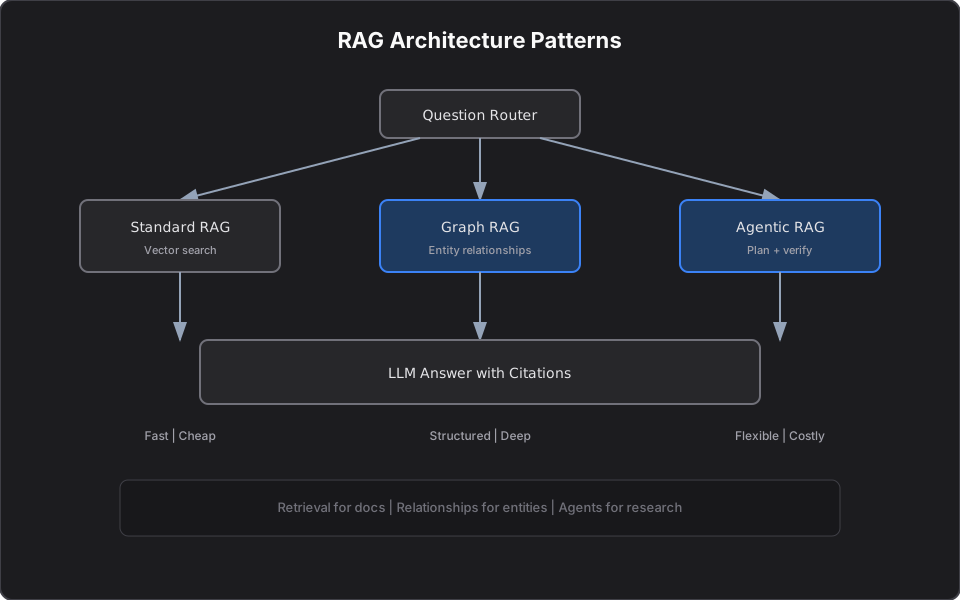
Short answer: Standard RAG is best when the answer lives in a few document chunks and speed matters. Graph RAG wins when relationships between entities drive the answer. Agentic RAG is worth the cost when the question needs planning, multiple retrieval steps, and self-correction. Most production systems use all three — routed by question type.
Large Language Models are powerful, but they do not automatically know your private, internal, or domain-specific data. That is where Retrieval-Augmented Generation comes in.
RAG connects an LLM to external knowledge — documents, filings, databases, APIs, transcripts, or internal wikis. Instead of asking the model to answer from memory, you retrieve relevant context first, then ask the model to answer using that context.
But not every RAG system is the same. In production, there are usually three patterns: Standard RAG, Graph RAG, and Agentic RAG. They sound similar; the trade-offs are very different.
For the retrieval layer underneath all three, see Embeddings and Vector Databases. For the broader platform picture, start with From AI Model Consumer to AI Application Builder.
Three patterns at a glance
| Pattern | Best for | Trade-off |
|---|---|---|
| Standard RAG | Document Q&A, FAQs, single-source summaries | Fast and cheap; weak on multi-hop questions |
| Graph RAG | Ownership, supply chain, entity relationships | Powerful; expensive to build and maintain |
| Agentic RAG | Compare, analyze, multi-source research | Flexible; slow, costly, harder to debug |
1. Standard RAG
Standard RAG is the most common architecture. The flow is simple:
1. The user asks a question. 2. The question is converted into an embedding. 3. The embedding is matched against a vector database. 4. The top matching chunks are retrieved. 5. The LLM generates an answer using those chunks as context.
Example: "Summarize the key risks mentioned in Reliance Industries' latest annual report."
A standard RAG system searches the annual report, retrieves the most relevant sections, and asks the LLM to summarize only from those sections. This works well when the answer is likely to exist in a small number of documents or chunks.
Where standard RAG works well
- Internal documentation search
- Policy Q&A and product manuals
- Knowledge base chatbots
- Annual report summarization
- Customer support and FAQ-style systems
For many teams, this is the best starting point: fast, relatively cheap, and easy to explain. You can build a working version with document storage, chunking, embeddings, a vector database, a retrieval API, and an LLM response layer.
The problem with standard RAG
Standard RAG depends heavily on retrieval quality. If the wrong chunk is retrieved, the answer will be wrong — and in a basic pipeline, nothing may catch that mistake.
Suppose a user asks: "Why did the company's margin decline even though revenue increased?"
The answer may require pulling data from the income statement, management discussion, notes to accounts, segment performance, commodity cost commentary, and previous-year comparison. A simple top-k vector search may retrieve only one or two relevant chunks. The LLM may then generate a confident answer from incomplete context.
Use standard RAG when the answer lives clearly inside your documents and speed matters.
2. Graph RAG
Graph RAG adds structure on top of retrieval. Instead of treating knowledge as isolated chunks, it models relationships between entities.
Examples:
- Company → Subsidiary → Product → Geography → Revenue Segment → Risk Factor
- Promoter → Shareholding Change → Filing → Stock Price Movement → News Event
This is useful when the answer depends not just on text similarity, but on relationships.
Pipeline overview
1. Extract entities from documents. 2. Identify relationships between entities. 3. Store entities and relationships in a graph. 4. Retrieve context by traversing the graph. 5. Use the LLM to synthesize the final answer.
Where graph RAG works well
- Legal research and compliance workflows
- Biomedical and investment research
- Company ownership structures and supply chain risk
- Fraud detection and regulatory intelligence
In finance, a question like "Which companies have exposure to both electric vehicles and lithium supply chain risk?" is not just a text search problem. A graph can connect Company → Business Segment → Raw Material → Supplier → Geography → Risk Event — a much deeper answer than keyword or vector search alone.
The cost of graph RAG
Graph RAG is powerful, but harder to build. You need entity extraction, entity resolution, relationship extraction, graph storage, traversal logic, and a strategy for updating the graph when source documents change.
Entity resolution alone is non-trivial. A company may appear as "Tata Consultancy Services," "TCS," "Tata Consultancy Services Ltd.," and "TCS Ltd." Your system must know these are the same entity. If it gets that wrong, the graph becomes noisy.
Use graph RAG when relationships between entities are more important than simple text similarity.
3. Agentic RAG
Agentic RAG adds planning and self-correction. Instead of one retrieval call, an agent decides what to do.
Typical flow
1. The user asks a question. 2. A planning agent breaks it into sub-questions. 3. The agent decides which sources to search. 4. It retrieves context from multiple systems. 5. An evaluator checks whether the retrieved context is enough. 6. If not, the agent searches again. 7. The final answer is generated after enough context is collected.
Example: "Compare HDFC Bank and ICICI Bank based on loan growth, asset quality, profitability, and management commentary from the last four quarters."
This is not a single retrieval problem. The system may need quarterly results, investor presentations, earnings call transcripts, financial ratios, management commentary, historical trend data, and peer comparison data. An agentic system can plan the work: what data is needed, which companies, which quarters, which metrics, and whether more context is required.
Where agentic RAG works well
- Multi-step reasoning across multiple data sources
- Tool usage, API calls, validation, and re-retrieval
- Comparison and summarization across documents
- Structured output for enterprise and finance workflows
Examples:
- Find companies where revenue increased but operating margin declined, then explain why using filings.
- Compare two mutual funds on portfolio overlap, expense ratio, rolling returns, and risk metrics.
- Analyze whether a company's debt risk is increasing from balance sheet, cash flow, and credit rating commentary.
The cost of agentic RAG
Agentic RAG is more capable, but also more expensive. It may involve more LLM calls, more retrieval calls, higher latency, more logging, more failure points, and more complicated debugging.
A simple RAG answer may take one LLM call. An agentic answer may take five, ten, or more depending on the workflow. Do not send every query through an agent.
Decision framework
| Question type | Best fit |
|---|---|
| "Summarize this document." | Standard RAG |
| "Answer from our internal wiki." | Standard RAG |
| "Find related entities and explain relationships." | Graph RAG |
| "Analyze ownership, subsidiaries, or supply chain." | Graph RAG |
| "Compare companies across multiple filings and metrics." | Agentic RAG |
| "Research using multiple tools and verify the answer." | Agentic RAG |
The simplest rule:
- Standard RAG for retrieval
- Graph RAG for relationships
- Agentic RAG for reasoning
Finance example: "Why did margins fall?"
Imagine building an AI research assistant for public company filings.
Standard RAG searches the latest filing for margin, revenue, cost, and management discussion chunks, then summarizes. Fast and useful — but it may miss context from previous quarters or related notes.
Graph RAG knows relationships like Company → Segment → Revenue, Company → Raw Material Cost, Company → Geography. It can connect margin decline to segments, cost drivers, geography, or subsidiaries.
Agentic RAG creates a plan: pull latest and prior quarter results, compare revenue and cost growth, check management commentary and segment performance, validate whether the decline is due to cost, mix, one-time expense, or pricing pressure, then produce a cited final answer. Slower — but much more useful for investment research.
Production architecture: use a router
For most real systems, I would not choose only one pattern. I would use a layered approach:
- Simple question → Standard RAG
- Relationship-heavy question → Graph RAG
- Complex research question → Agentic RAG
The router becomes very important. A good production system should first classify the user's question — with a lightweight classifier, rules, or a small model — then route to the right pipeline. Do not send every query through the most expensive path.
public enum RetrievalMode
{
    StandardRag,
    GraphRag,
    AgenticRag
}

public sealed class RetrievalRouter
{
    public RetrievalMode Route(string userQuestion)
    {
        var question = userQuestion.ToLowerInvariant();

        if (question.Contains("compare") ||
            question.Contains("why") ||
            question.Contains("analyze") ||
            question.Contains("last four quarters"))
        {
            return RetrievalMode.AgenticRag;
        }

        if (question.Contains("relationship") ||
            question.Contains("subsidiary") ||
            question.Contains("ownership") ||
            question.Contains("supply chain"))
        {
            return RetrievalMode.GraphRag;
        }

        return RetrievalMode.StandardRag;
    }
}
This is simplified — production routers use embeddings, intent classifiers, and telemetry — but the idea is essential: match architecture to question type.
What to build first
If I were building this for a finance platform, I would start in this order:
Phase 1 — Standard RAG: filings, annual reports, investor presentations, earnings transcripts. Document ingestion, chunking, embeddings, vector search, source citations, basic Q&A. Immediate value.
Phase 2 — Better retrieval: before jumping to agents, improve retrieval quality. Add metadata filters (company symbol, filing type, date), re-ranking, query rewriting, and an evaluation test set. Many RAG systems fail because retrieval is weak, not because the LLM is bad.
Phase 3 — Agentic workflows: add agents only for complex workflows — compare two companies, analyze quarterly performance, detect risk changes, generate investor briefings.
Phase 4 — Graph layer: add graph RAG when relationships become core — promoter ownership, subsidiaries, related-party transactions, supply chain exposure, regulatory events. This can become a strong moat because the system builds structured intelligence, not just document search.
Common mistakes
- Using agentic RAG for everything — slow and expensive without proportional value.
- Building a graph too early — poor entity extraction produces a noisy, unreliable graph.
- Ignoring evaluation — without test questions for retrieval accuracy, citations, refusals, and hallucinated numbers, it is hard to trust the system.
Final takeaway
Standard RAG, Graph RAG, and Agentic RAG are not competitors. They are different tools.
Standard RAG is fast, cheap, and useful when the answer exists in documents. Graph RAG is powerful when relationships matter. Agentic RAG is best when the question requires planning, multiple retrieval steps, and self-correction.
The best production systems will likely use all three. The real skill is knowing when each pattern is worth the cost.
Start with Standard RAG. Improve retrieval quality. Add agents for complex workflows. Add graph only when relationships become core to the product.
That is how you move from a basic chatbot to a real intelligence system.
Related reading
- Embeddings and Vector Databases — the search layer behind RAG
- Private RAG Systems Without External APIs — self-hosted retrieval architecture
- From AI Model Consumer to AI Application Builder — the full platform progression
- Building Your First MCP Server in C# — connecting AI to live systems alongside RAG
Frequently asked questions
- When should I use standard RAG?
- Use standard RAG when the answer likely lives in a small number of document chunks — FAQs, policy Q&A, document summaries, and knowledge base search where speed and simplicity matter.
- What is Graph RAG used for?
- Graph RAG is best when relationships between entities drive the answer — ownership structures, supply chains, subsidiaries, legal relationships, and cross-entity analysis in finance or compliance.
- When is Agentic RAG worth the cost?
- Agentic RAG is worth it when questions require planning, multiple retrieval steps, tool use, and self-correction — such as comparing companies across filings, multi-source research, or verified analysis workflows.
Related reading
Embeddings and Vector Databases: The Search Layer Behind Real AI Applications
Embeddings convert meaning into vectors; vector databases make those vectors searchable. Together they form the retrieval foundation behind RAG, semantic search, and enterprise AI assistants.
From AI Model Consumer to AI Application Builder
A practical guide for .NET engineers moving from chat prompts to RAG, MCP servers, agents, and agentic workflows — with security patterns, architecture diagrams, and platform mental models.
Private RAG Systems Without External APIs
Mid-sized teams can build secure, self-hosted AI assistants with open-source models, vector stores, and RAG — without routing proprietary data through third-party APIs.