How Software Engineering Teams Should Look in the AI Era
Summary
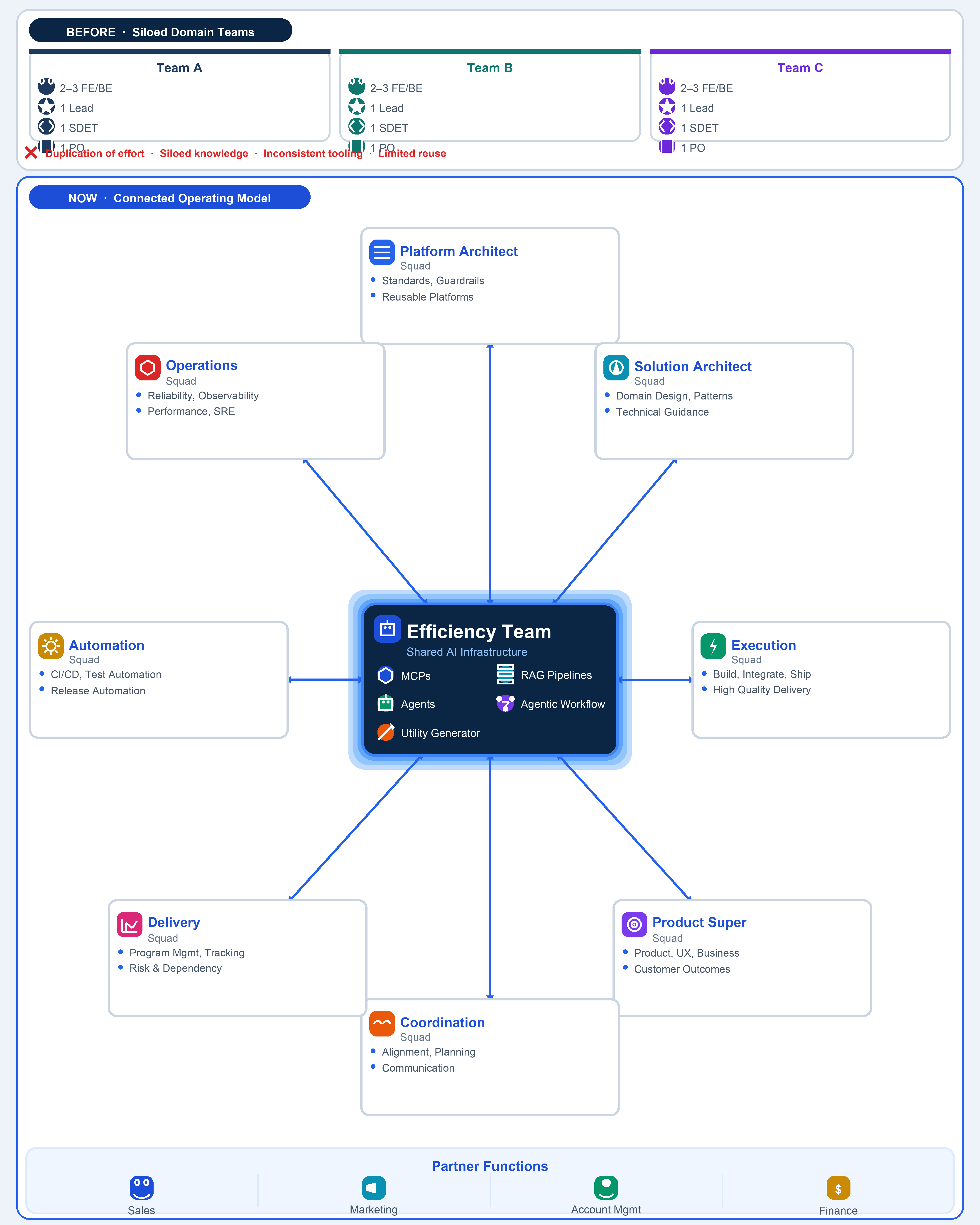
The traditional model repeats the same roles across siloed domain teams. The AI-era model connects specialized squads through an Efficiency Team building shared MCPs, RAG pipelines, agents, and agentic workflows.
AI is changing more than how engineers write code. It is changing how software organizations should be structured.
For years, the default pattern has been simple: clone the same delivery team across every domain. Each silo gets its own front-end and back-end engineers, lead, QA, and product owner. That model works until it does not — duplicated tooling, siloed knowledge, inconsistent delivery, and limited reuse become the tax you pay on every new domain.
The AI era pushes a different question: not "how many full-stack teams can we afford?" but "how much leverage can each specialized squad create when shared AI infrastructure amplifies everyone?"
The before model: siloed domain teams
The traditional structure repeats the same roles in every domain team:
| Role | Typical count | Responsibility |
|---|---|---|
| FE / BE engineers | 2–3 | Build and maintain domain features |
| Lead / manager | 1 | Team direction and delivery |
| SDET | 1 | Quality and test automation |
| Product owner | 1 | Requirements and prioritization |
Domain Team A, Domain Team B, Domain Team C — same stack, same rituals, same tooling rebuilt from scratch.
That repetition creates predictable failure modes:
- Duplication of effort — every team builds its own scripts, dashboards, and AI experiments
- Siloed knowledge — architecture decisions stay local; patterns do not travel
- Inconsistent tooling — one team uses one agent framework; another uses something else entirely
- Limited reuse — MCP servers, RAG pipelines, and agent workflows live in individual repos instead of a platform
None of this is a people problem. It is an operating model problem.
The now model: connected operating squads
The connected model replaces repeated full stacks with specialized squads that share a central Efficiency Team building MCPs, RAG pipelines, agents, and agentic workflow utilities for the whole organization.
Think of it as hub-and-spoke platform leverage:
Specialized squads (architecture, execution, product, delivery, ops)
        ↕ shared AI infrastructure ↕
            Efficiency Team
        (MCPs · RAG · Agents · Workflows)
Efficiency Team — shared AI infrastructure
The Efficiency Team is not another feature team. It is the platform layer for AI-assisted engineering:
- MCPs — standardized tool surfaces so agents can reach approved systems safely
- RAG pipelines — retrieval over architecture docs, runbooks, and domain knowledge
- Agents — reusable assistants for code review, incident triage, test scaffolding
- Agentic workflows — multi-step pipelines with human approval gates where state changes
If you are building MCP servers in production, the same ideas apply on Kubernetes: host the server, scale it, and keep authorization in the application layer — see Running MCP Servers on Kubernetes.
The eight squads
Each squad owns a high-leverage slice of the delivery system. Every squad connects back to the Efficiency Team for shared AI capability — not duplicated local tooling.
| Squad | Focus |
|---|---|
| Platform Architect | Cross-domain standards, guardrails, reusable platforms |
| Solution Architect | Domain design, patterns, technical guidance with business context |
| Execution | Build, integrate, ship — high-quality delivery from architecture direction |
| Product Super | Product, UX, business, and customer outcomes |
| Coordination | Alignment, planning, communication across squads |
| Delivery | Program management, tracking, risk and dependency management |
| Automation | CI/CD, test automation, release automation |
| Operations | Reliability, observability, performance, SRE |
This is not bureaucracy for its own sake. It is specialization with shared leverage — the same principle behind platform engineering, applied to the AI layer.
Partner functions
Engineering does not operate in isolation. Sales, Marketing, Account Management, and Finance remain partner functions — connected to outcomes, not buried inside every domain silo.
Finance in particular shapes how engineering leaders think about build-vs-buy, platform ROI, and cost of duplicated effort — themes I explore in What Finance Taught Me About Engineering Decisions.
What this is not
This model is not:
- A reason to add headcount without removing duplication
- An excuse to centralize every decision in one architecture committee
- A replacement for domain expertise — Solution Architect and Product Super squads exist precisely because domains still matter
The goal is to replace repeated effort with shared capabilities that improve the productivity of every squad.
AI will not eliminate engineering teams. It will force us to redesign how they work together — from AI model consumer habits to agentic workflows that retrieve, act, and pause for review.
A practical migration path
You do not flip org charts overnight. A realistic sequence:
- Name the duplication — inventory where each domain team rebuilt the same AI tooling, test harnesses, or release scripts
- Stand up a thin Efficiency Team — start with one MCP server, one RAG corpus, one approved agent workflow that two squads actually use
- Pull architecture out of silos — Platform and Solution Architect squads publish patterns; Execution ships against them
- Keep partner functions visible — Finance and account teams stay in the operating rhythm, especially when platform investments need ROI language
- Measure leverage, not activity — fewer rebuilt pipelines, faster time-to-production for new domains, higher reuse of MCP tools across teams
| Signal you are moving correctly | Signal you are adding bureaucracy |
|---|---|
| Two squads use the same MCP server | Every squad still maintains its own agent fork |
| RAG answers cite internal runbooks | Engineers still paste logs into public chat |
| Architecture decisions publish once | Every domain team debates the same standard |
| Efficiency Team backlog is squad-driven | Efficiency Team builds tools nobody requested |
Start where you are
If your organization still looks like three identical domain teams, you are not behind — you are at the starting line most enterprises share.
The shift is conceptual first: treat MCPs, RAG, agents, and workflows as shared infrastructure, not side projects inside every team. Then let the org structure follow the leverage you want.
The diagram below summarizes the before-and-after operating model — siloed repetition on top, connected squads with shared AI infrastructure below.
---
Related reading
Frequently asked questions
- What is an Efficiency Team in the AI era?
- An Efficiency Team builds shared AI infrastructure — MCPs, RAG pipelines, agents, and agentic workflow utilities — that every specialized squad uses instead of rebuilding tooling in each domain silo.
- What is wrong with siloed domain teams?
- Each team repeats the same delivery structure — engineers, leads, QA, and product owners — which duplicates effort, silos knowledge, and limits reuse of AI tooling and platform patterns.
- What squads replace the traditional domain team model?
- Platform Architect, Solution Architect, Execution, Product Super, Coordination, Delivery, Automation, and Operations squads — all connected through shared AI infrastructure rather than isolated full stacks.
Related reading
From AI Model Consumer to AI Application Builder
A practical guide for .NET engineers moving from chat prompts to RAG, MCP servers, agents, and agentic workflows — with security patterns, architecture diagrams, and platform mental models.
Running MCP Servers on Kubernetes
An MCP server is just an HTTP service — run it on Kubernetes as a Deployment and Service with probes, autoscaling, and Secrets Manager. The MCP-specific decisions explained.
Model Context Protocol Tools, Resources, and Prompts Explained
Understand MCP tools, resources, and prompts with practical examples for AI agents, enterprise workflows, and developer productivity.